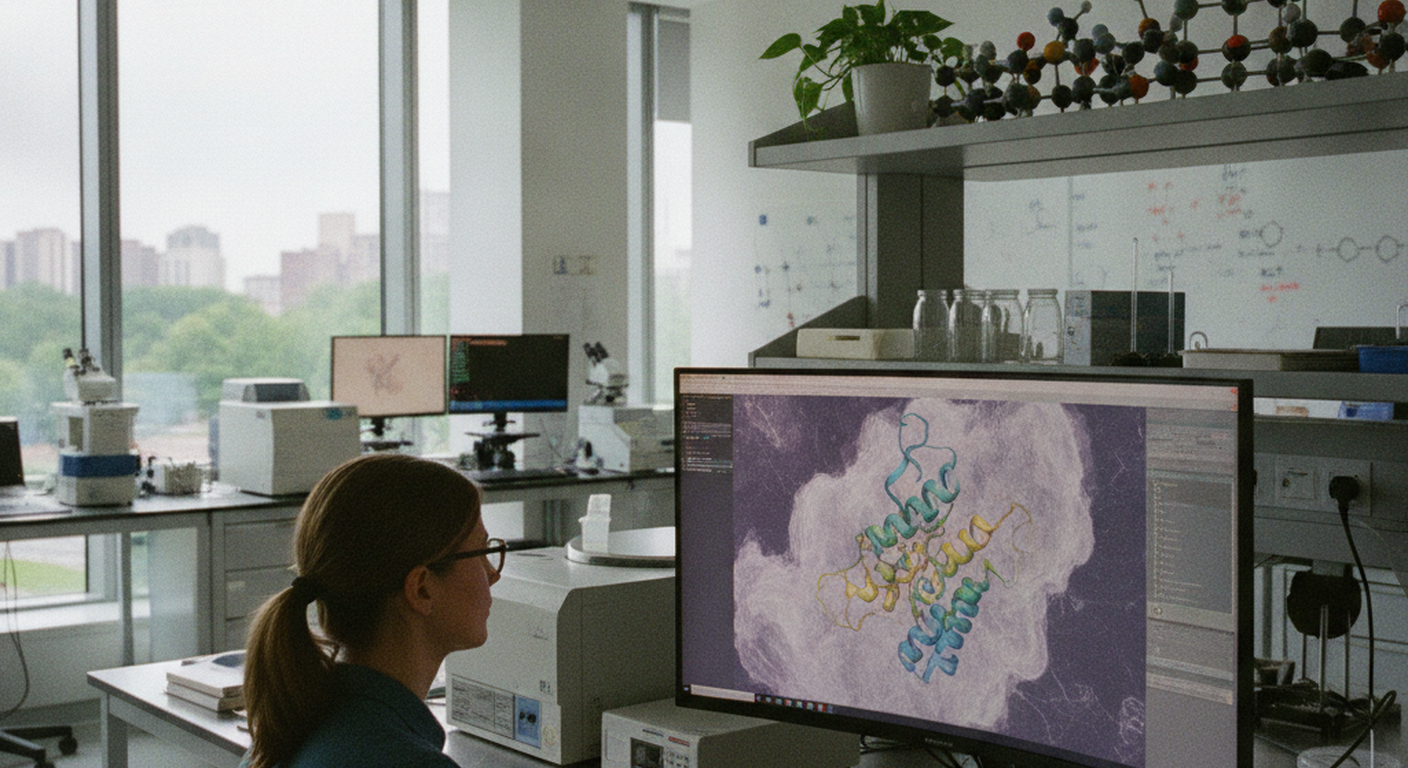
AlphaFold effectively solved single-structure prediction. But function is motion — enzymes open and close, receptors switch on and off, transporters flip inward and outward — and a single static coordinate set can be actively misleading when the biology lives in a minor or transient state. Our Protein Conformation survey maps every family of methods that goes beyond one structure. Here's what BioMate makes runnable.
Why one structure isn't enough
The survey organizes the field into five families: static prediction (the baseline), physics-based molecular dynamics (the gold standard for mechanism, but expensive), generative ensemble models (fast, but mostly equilibrium ensembles — not time-ordered "movies"), cryo-EM heterogeneity (the strongest experimental grounding), and integrative modeling of disordered proteins. The honest verdict: no single method wins, and the reliable route combines a fast prior, physics for mechanism, and experimental data to validate.
What BioMate does
- Cryo-EM conformational heterogeneity, end-to-end. Production workflows on AWS Batch run single-particle processing and heterogeneity analysis — the cryoDRGN / cryoSPARC family (3D variability, 3DFlex) — to recover multiple discrete states and continuous motion directly from a user's own particle stack, with live progress and downloadable results.
- Generative conformational ensembles. An ensemble-generation capability produces many candidate conformers for a sequence — the fast, BioEmu-style equilibrium-ensemble approach — useful for cryptic-pocket discovery and as structural priors for docking.
- Wired into the platform. Structure and ensemble outputs feed the same plain-English, quality-graded pipeline as BioMate's docking, ADMET, and structural-biology workflows.
Where BioMate fits in the comparison
BioMate isn't a new algorithm in this space — it's the orchestration and accessibility layer that makes the published state of the art runnable at scale, without a structural-biology compute team. Given the survey's finding that experimental cryo-EM heterogeneity is the strongest grounding for multi-state models, making those exact methods one plain-English request away is the practical contribution.
Honest boundaries
The survey's cautions apply to results produced on the platform too: equilibrium ensembles are not trajectories, computational ensembles need experimental validation, and large collective transitions remain hard for every method. BioMate runs the state of the art honestly — it doesn't overstate it.
Go deeper: the full survey
This showcase is one half of a pair. For the complete, verified-citation map of the field — every method, honest strengths and limits, and what is actually winning — read the Protein Conformational Ensembles & Dynamics survey.