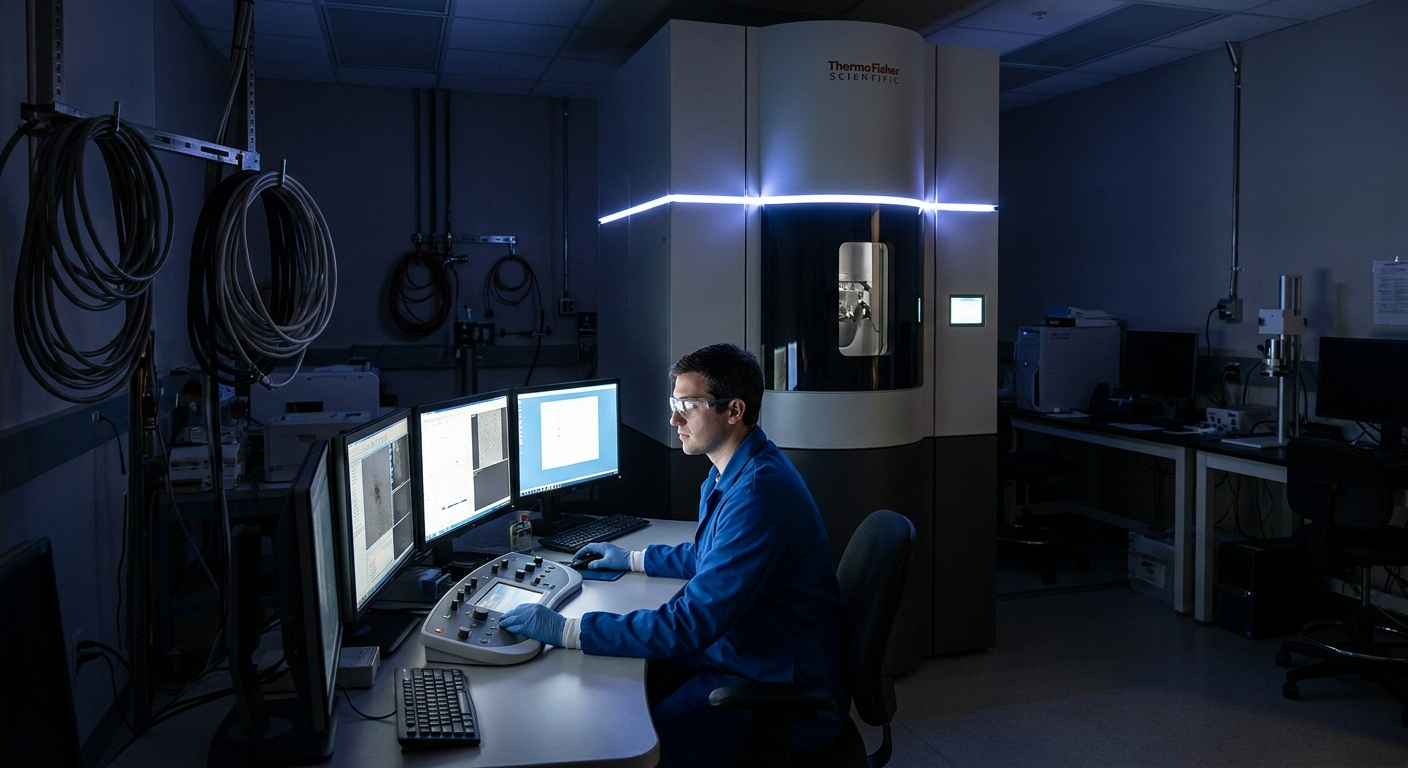
A single cryo-EM data collection session generates terabytes of raw micrographs and can require days of interactive processing to produce a final density map. BioMate automates the standard single-particle analysis pipeline — from raw micrograph frames to a validated, publication-ready reconstruction — with QC gates at every stage and a structured report when the run completes.
The Processing Challenge
Single particle cryo-EM processing involves a long sequence of interdependent steps, each with parameters that affect downstream quality. Motion correction aligns frames within each micrograph to remove beam-induced motion. CTF estimation characterizes the contrast transfer function that determines how spatial frequencies are modulated by the electron optics. Particle picking finds individual protein complexes within the motion-corrected micrographs. Two-dimensional classification separates particles into structurally homogeneous classes. Three-dimensional reconstruction builds an initial model. Heterogeneous refinement separates conformational states. Final homogeneous refinement and polishing produce the highest-resolution map.
Each of these steps has parameters that interact with the data quality, the specimen, and the stage before it. Getting them right typically requires an experienced cryo-EM specialist — someone who can look at a 2D class average and recognize that a specific artifact pattern indicates a misalignment problem three steps earlier in the pipeline.
BioMate's Automated Pipeline
BioMate orchestrates the complete CryoSPARC single-particle analysis pipeline, applying evidence-based default parameters calibrated for common specimen types and data collection conditions. At each stage, a QC gate evaluates the output: motion correction quality, CTF fit resolution, particle yield and quality score distribution, 2D class resolution and occupancy, and the final map resolution by the gold-standard FSC criterion.
"The FSC resolution is the metric reviewers check first. But the particle count, the B-factor, the map-to-model fit, and the class distribution tell the story of how you got there — and whether the result is trustworthy."
QC Report and Findings
When the pipeline completes, BioMate generates a structured quality report that includes the processing statistics at each stage, the FSC curve with the gold-standard resolution estimate, particle statistics, and a map visualization summary. The report is formatted to support the Methods section of a manuscript — with the specific software version, parameter settings, and QC outcomes recorded in the audit trail.
Further reading: CryoSPARC official site, RELION (MRC Laboratory of Molecular Biology), EMDB — Electron Microscopy Data Bank, and RCSB Protein Data Bank.
A cryo-EM session that ended at 6am can be fully processed, QC-evaluated, and ready for interpretation by the time the team arrives in the morning — without requiring a specialist to babysit the pipeline overnight.