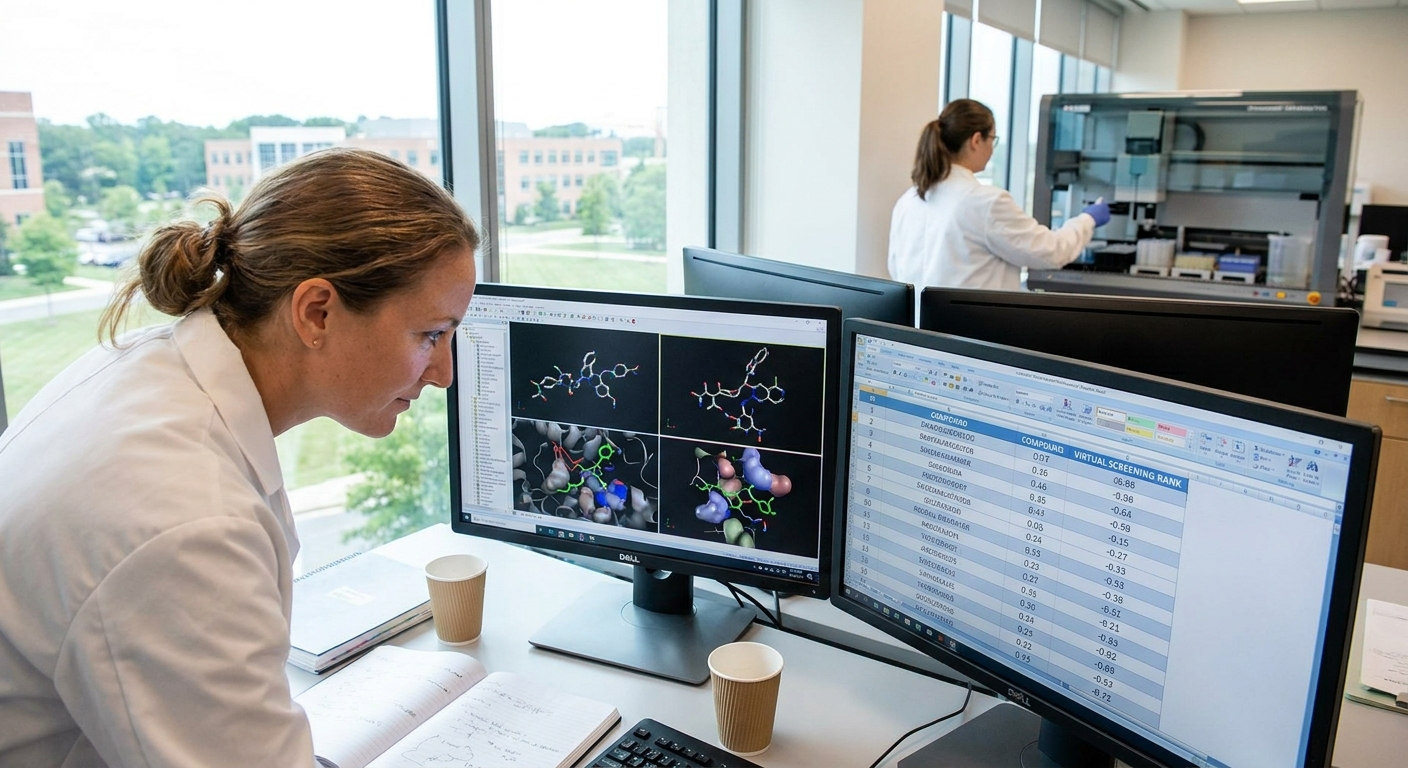
Physical high-throughput screening is powerful but finite: it is limited by the size of your compound collection, the cost of the assay, and the throughput of your robotics. Computational virtual screening removes those limits — evaluating millions of molecules in the time it takes to set up a single plate-based assay, filtering the hit list to those most likely to succeed before any compound is purchased or synthesized.
The Scale Advantage
Commercial compound libraries contain millions of purchasable molecules. Enumerated virtual libraries of synthesizable compounds can reach into the billions. No physical screen can evaluate this space. Computational methods can, and the quality of the hits they return has improved dramatically as the underlying methods have moved from rigid docking to flexible, deep-learning-guided screening.
The practical question is not whether to use computational screening, but how to use it well — which methods to apply, in what order, with what filters, to produce a hit list that will perform well in the assay that follows.
Layered Screening in BioMate
BioMate orchestrates virtual screening as a funnel. Deep-learning-based screening rapidly scores very large compound libraries using learned representations of protein-ligand complementarity, dramatically reducing the candidate set before more computationally expensive methods are applied. Rigid and flexible molecular docking then evaluates the reduced set at higher resolution, generating binding poses and scoring them based on predicted interaction geometry. Pharmacophore filtering adds a shape and feature-based layer that catches compounds the docking score alone might rank incorrectly.
At each stage, the system applies early ADMET triage — eliminating compounds with known liabilities such as excessive molecular weight, poor solubility, or reactive functional groups — so the hit list entering the assay is pre-filtered for developability, not just binding affinity.
"The goal of virtual screening is not to find the molecule with the best docking score. It is to find the molecules that will survive the full development process."
What Comes Out
BioMate returns a ranked hit list with binding poses, scores across multiple methods, ADMET liability flags, synthesizability estimates, and diversity clustering — giving the medicinal chemistry team everything they need to make a prioritized selection for assay follow-up. The full screening provenance, including which library was screened, which methods were applied, and all intermediate scores, is captured in the audit trail.
Further reading: AutoDock (Scripps Research), ZINC compound database (UCSF), ChEMBL bioactivity database (EBI), and PubChem (NIH).
Your assay list starts with compounds that are already filtered for binding geometry, ADMET acceptability, and structural diversity — without running a single physical screen. The hit rate from biological follow-up is higher, and the cost per confirmed hit is lower.