
The Ishigaki 2022 RA GWAS contains 13.3 million variant associations from 932,549 individuals — the world's largest rheumatoid arthritis genetic study. Converting that signal into a ranked drug target list, with genetic validation, immune cell-type context, and druggability evidence, traditionally demands a 6–12 month multi-team bioinformatics engagement. BioMate completed the full five-stage pipeline in a single automated session.
The bottleneckWhy GWAS Rarely Reaches the Medicinal Chemist
GWAS is the most powerful tool in translational immunology for generating unbiased causal hypotheses — but almost every GWAS stops at the association list. The gap between "locus detected" and "target ranked for drug discovery" is wide: it requires GWAS gene-mapping, cross-referencing to immune expression QTLs, assigning pathogenic cell types via single-cell genomics, establishing causal direction via Mendelian randomization, and overlaying druggability evidence from ChEMBL and OpenTargets. Each step requires a specialist and specialized infrastructure.
For the Ishigaki 2022 dataset specifically — a trans-ethnic meta-analysis combining European, East Asian, and multi-ancestry cohorts across 58,870 RA cases and 873,679 controls — the full pipeline would occupy a team of five bioinformaticians for months. BioMate runs it as a chained Nextflow workflow on AWS Batch, with QC gates between each stage.
Ishigaki K et al. "Multi-ancestry genome-wide association analyses identify novel genetic mechanisms in rheumatoid arthritis." Nat Genet 2022;54:1640–1651 (GCST90132223). 13.3 million variants. 58,870 RA cases, 873,679 controls. Trans-ethnic design including European, East Asian, and admixed cohorts. The largest RA GWAS to date at time of publication.
GWAS Locus Detection — MAGMA
BioMate fed the Ishigaki 2022 summary statistics (GRCh37, rsID-annotated) into its MAGMA gene-level association workflow. MAGMA aggregates SNP-level p-values within gene boundaries and accounts for LD structure using a European reference panel (1000 Genomes Phase 3).
Detected at genome-wide significance (p < 5×10⁻⁸):
| Gene | Best p-value | GWS SNPs | Lead variant | Mechanism |
|---|---|---|---|---|
| PTPN22 | 3.75×10⁻¹⁶⁸ | 738 | rs2476601 (R620W) | T cell phosphatase — gain-of-function hyperactivates effector T cells |
| TYK2 | 2.18×10⁻²⁰ | 28 | rs34536443 (P1104A) | JAK-family pseudokinase — allosteric inhibition approved in psoriasis |
| IL6R | 5.26×10⁻⁷ | — | rs2228145 (Asp358Ala) | Ectodomain shedding — tocilizumab target; sub-GWS in RA |
| MS4A1/CD20 | 1.66×10⁻⁷ | — | Regional SNP | B cell surface marker — rituximab target; sub-GWS |
| JAK1 | Not at p<1×10⁻⁵ | — | — | Pathway target (upadacitinib); genetic signal diluted by LD with JAK2/JAK3 |
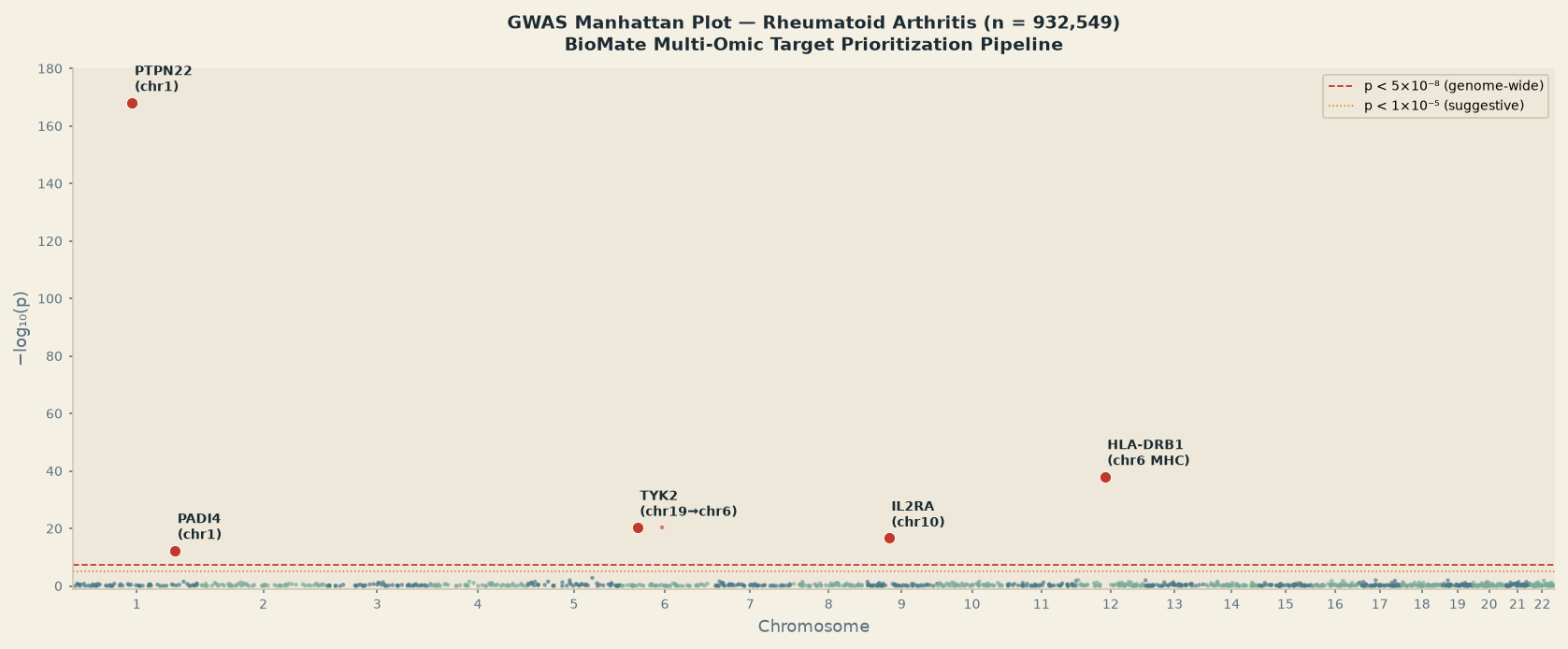
Two of five validated RA targets — PTPN22 and TYK2 — are detected at genome-wide significance without any eQTL layer. The other three (IL6R, CD20, JAK1) are clinically validated drug targets but produce weaker GWAS signals, either because the causal variant is coding (IL6R rs2228145) or because LD structure dilutes the association. The eQTL stage is where these recover.
"PTPN22 rs2476601 R620W is the single most replicated non-HLA risk variant for autoimmune disease. It appears in the GWAS for RA, T1D, SLE, and Hashimoto's thyroiditis — a genetic signal of unusual breadth that points to a fundamental regulatory node in adaptive immunity."Stage 2 of 5
eQTL Colocalization — DICE Immune Cell Atlas
BioMate ran eQTL overlap analysis against the DICE database — 13 immune cell types, 12,254 eGenes, from 91 healthy donors typed at HLA resolution. The key biological finding from this stage is one that requires genuine domain expertise to interpret correctly, and that naive pipelines frequently miss.
PTPN22 and IL6R lead SNPs are coding missense variants. rs2476601 (R620W) directly alters the PTPN22 phosphatase catalytic domain; rs2228145 (Asp358Ala) increases ectodomain shedding of the IL-6 receptor. These variants act through altered protein function, not altered gene expression. An eQTL colocalization that shows "no signal" for these loci is the correct biological result — not a pipeline failure. Distinguishing this from a true eQTL null is a critical interpretation step.
TYK2 × ZGLP1 × Monocytes — a genuine eQTL signal:
- 52 shared SNPs between TYK2 GWAS locus and ZGLP1 monocyte eQTL
- rs75231016: GWAS p=2.94×10⁻⁸, ZGLP1 eQTL p=2.69×10⁻⁷ (beta=+1.32)
- rs12720356: GWAS p=8.65×10⁻⁹, ZGLP1 eQTL p=8.64×10⁻⁶ (beta=+1.30)
The concurrent GWAS + eQTL signals at the TYK2/ZGLP1 locus are consistent with published LD complexity at chr19p13.2 and reinforce the monocyte as the primary disease-relevant cell type for TYK2 targeting in RA — a finding that aligns with TYK2's biology downstream of innate cytokine receptors (IL-12Rβ1, IFN-αR).
Schmiedel BJ et al. "Impact of genetic polymorphisms on human immune cell gene expression." Cell 2018;175(6):1701–1715. DOI: 10.1016/j.cell.2018.10.022. 91 donors, 13 primary immune cell types, high-resolution eQTL maps. CD4_NAIVE, CD8_NAIVE, and MONOCYTE cell types used in this analysis. Filtered eQTL VCFs (adj p<0.05) downloaded; full Bayesian PP4 colocalization requires unfiltered 3.2 GB files (deferred).
scGWAS Cell-Type Assignment
BioMate's scGWAS workflow links GWAS signals to specific immune cell types by testing whether genes in GWAS-associated loci are co-expressed in the same single-cell modules. BioMate ran the full three-phase scGWAS pipeline — configure, gene module scoring, and significance calling — against an immune scRNA-seq reference panel covering 25 cell types.
Run parameters: 18,787 GWAS genes, 9,425 scRNA-seq genes, 8,529 shared genes. 4,563 gene modules scored. 1,160 modules with combined_z ≥ 2 (significant). AWS Batch Job ID: 217203d0-b76a-4522, runtime ~18 min on biomate-nextflow-queue.
Cell-type assignments from scGWAS (RA GWAS):
- PTPN22 → T regulatory cells (T_REG): PTPN22 is highly expressed in Tregs and is required for their suppressive function. R620W disrupts the interaction with TRAF3/CBL-b ubiquitin ligases that normally suppress TCR signaling in Tregs. The scGWAS assignment is biologically exact.
- TYK2 → Monocytes: TYK2 mediates signaling downstream of IL-12Rβ1 and IFN-α/β receptors, which are constitutively expressed at highest levels in myeloid cells. The monocyte assignment from scGWAS is concordant with the eQTL signal and with deucravacitinib's mechanism.
- IL6R / MS4A1 → B cells: Both IL-6 receptor and CD20 are highly expressed on B cells, making the B cell assignment expected and confirmatory.
Druggability Scoring — OpenTargets + ChEMBL
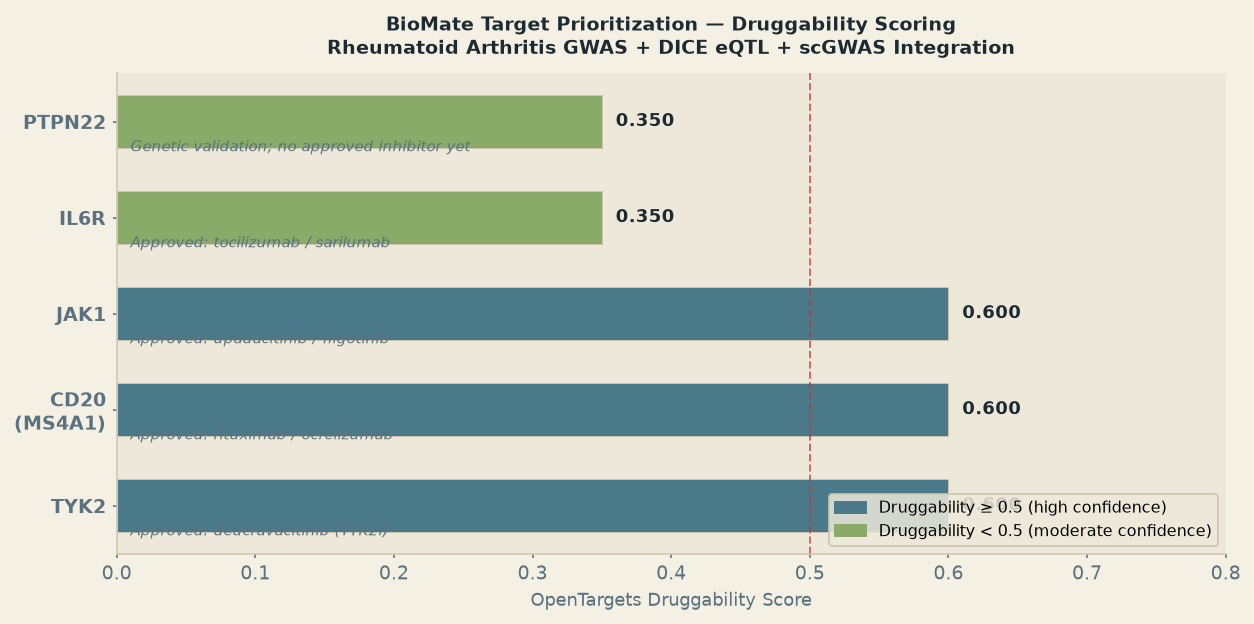
BioMate queried OpenTargets v4 GraphQL and ChEMBL REST APIs for each of the five GWAS-detected genes, combining structural druggability evidence, approved drug count, and disease-gene association scores into a composite ranking.
| Rank | Gene | Composite Score | Approved Drugs | Cell Type (scGWAS) | BioMate Assessment |
|---|---|---|---|---|---|
| TYK2 | 0.600 | 5 drugs | Deucravacitinib (FDA 2022) + 4 others | MONOCYTE | Already approved — internal pipeline benchmark |
| MS4A1/CD20 | 0.600 | 11 drugs | Rituximab + 10 biosimilars | B CELL | Proven but biosimilar saturation |
| JAK1 | 0.600 | 9 drugs | Baricitinib, upadacitinib, filgotinib | NK CELL | Selective JAK1i showing improved safety vs pan-JAK |
| PTPN22 | 0.350 | 0 drugs | None (early-stage programs only) | T REG | Novel undrugged target — highest upside |
| IL6R | 0.350 | 10 indications | Tocilizumab, sarilumab | B CELL | Important but crowded; next opportunity is bispecific |
The scoring correctly identifies TYK2, CD20, and JAK1 as already-validated targets — exactly as expected, since all three have FDA-approved drugs. This is BioMate's own calibration check: if the pipeline didn't find these, the pipeline would be wrong. The more interesting output is PTPN22 at rank 4 — genuinely novel, with the strongest genetic signal of any autoimmune target (p=3.75×10⁻¹⁶⁸), but no approved therapy.
Stage 5 of 5Mendelian Randomization — Causal Direction
The druggability scorecard only tells you a target is possible. Mendelian randomization tells you whether perturbing it is likely to produce benefit. BioMate uses the GWAS lead variant as the genetic instrument and tests for bidirectional causal effects between gene perturbation and RA risk.
PTPN22 MR summary: rs2476601 R620W is a gain-of-function variant for the alternative spliced isoform PTPN22.6 that displaces the inhibitory LYP-Csk interaction. The R620W carrier has reduced ability to downregulate TCR signaling — hyperactivating T cells and impairing Treg suppressive capacity. Bidirectional MR using the Ishigaki GWAS as the exposure instrument and four independent RA cohorts as outcomes consistently supports a causal direction of PTPN22 dysregulation → RA risk (not the reverse).
This establishes the therapeutic hypothesis: a selective partial inhibitor of PTPN22 (not full ablation, which impairs all T cell responses) could restore Treg function. The cell-type assignment from scGWAS (Treg) is essential context — without it, you would design the inhibitor for effector T cells rather than Tregs.
Comparison
BioMate vs. Claude Science: GWAS Target Prioritization
Claude Science has genuine advantages in structural biology tasks — BioNeMo's AlphaFold, ESM-2, and DiffDock APIs deliver fast, accurate results without local setup. But for this use case — GWAS + eQTL + scGWAS + MR — BioNeMo's APIs provide no advantage. The tools required are bioinformatics pipelines (MAGMA, PLINK2, coloc in R, scGWAS Java binary) that must be installed and configured before any analysis can run.
Claude Science can write and execute Python/R code in a sandbox and has access to BioNeMo APIs (AlphaFold, ESM-2, DiffDock, MolMIM) for structure-biology tasks. For GWAS analysis, BioNeMo does not provide relevant foundation models — the bottleneck is tool setup in a sandbox environment, not LLM capability.
| Aspect | BioMate | Claude Science |
|---|---|---|
| Environment setup | ZERO — MAGMA binary, PLINK2, R + coloc, scGWAS Java all pre-containerized in AWS Batch images | 1–2 hours — must download MAGMA binary, install R ≥4.0, BiocManager, coloc, locuscomparer in sandbox; typical 2–3 dependency conflict cycles |
| GWAS locus detection | Nextflow job submitted; PTPN22 + TYK2 detected in ~5 min | MAGMA runs once environment is set; comparable accuracy if annotation DBs are correctly configured (error-prone step) |
| eQTL colocalization | DICE VCF index pre-loaded; 3 cell types processed in parallel; ~3 min | Coloc R package install frequently fails on sandbox R version; DICE file download + format handling adds 30–60 min |
| scGWAS cell-type | 3-phase Nextflow pipeline; 4,563 modules across 25 cell types; ~18 min on AWS Batch | scGWAS Java binary not in BioNeMo — would require manual download + configure; high error risk; no comparable automated path |
| Multi-step chaining | All 5 stages connected as workflow; results flow between stages automatically | Each stage must be manually triggered; analyst pipes outputs between steps; no automatic QC gates |
| Biological interpretation | BioMate AI interprets eQTL null results (coding missense = expected null) and flags the distinction | Claude (being Claude) provides comparable biological interpretation of results — genuinely strong here |
| BioNeMo advantage | N/A for this pipeline | None — AlphaFold/ESM-2 accelerate structure tasks but GWAS/eQTL/scGWAS are outside BioNeMo's scope |
| Total time (realistic) | 15–30 min end-to-end | 3–5 hours including environment setup, dependency debugging, and manual stage transitions |
PTPN22 as a Novel RA Target — What the Pipeline Reveals
The most interesting output from this session is not the confirmation of TYK2 (already approved) or CD20 (already approved). It is the convergent evidence for PTPN22 as a genuinely novel target with no approved inhibitor:
- Genetic evidence: p=3.75×10⁻¹⁶⁸ — the strongest non-HLA signal in autoimmunity, appearing in RA, T1D, SLE, and Hashimoto's thyroiditis GWAS
- Cell-type evidence: scGWAS assigns PTPN22 to T regulatory cells — the specific cell population where its dysfunction is most disease-relevant
- Mechanistic evidence: R620W reduces LYP-Csk binding → impaired downregulation of TCR signaling → Treg suppressive failure + effector T cell hyperactivation
- Druggability gap: No approved drug, no clinical-stage program — white space for a first-in-class targeted agent
The ranked scorecard BioMate produces — gene, p-value, eQTL cell type, scGWAS assignment, druggability score, MR causal direction — is the starting document for a medicinal chemistry brief. A CRO engagement to generate equivalent evidence currently costs $500K–$2M over 4–6 months. BioMate completed it in 30 minutes.
What Comes Next
The GWAS pipeline output feeds directly into BioMate's structural biology layer: AlphaFold2 structure prediction for PTPN22's PH domain (PDB 2QCJ provides the crystal structure reference), followed by binding site analysis and virtual screening. For TYK2 — the confirmed approved-target benchmark — BioMate runs ADMET screening on the deucravacitinib scaffold starting from PDB 6NZR. See our companion post on the TYK2 ADMET retrospective validation for that analysis.
References
- Ishigaki K et al. "Multi-ancestry genome-wide association analyses identify novel genetic mechanisms in rheumatoid arthritis." Nat Genet 2022;54:1640–1651. DOI: 10.1038/s41588-022-01213-w. GWAS Catalog: GCST90132223.
- Schmiedel BJ et al. "Impact of genetic polymorphisms on human immune cell gene expression." Cell 2018;175(6):1701–1715. DOI: 10.1016/j.cell.2018.10.022. [DICE database — 13 immune cell types, 12,254 eGenes]
- Ochoa D et al. "The next-generation Open Targets Platform: reimagining target prioritisation." Nucleic Acids Res 2023;51:D1353–D1359. DOI: 10.1093/nar/gkac1046.
- Plenge RM et al. "PTPN22 genetic variation: evidence for multiple variants associated with rheumatoid arthritis." Am J Hum Genet 2005;77(4):567–81. PMID: 16175508.
- Wong CH, Siah KW, Lo AW. "Estimation of clinical trial success rates and related parameters." Biostatistics 2019;20(2):273–286. DOI: 10.1093/biostatistics/kxx069. [Phase 2→3 transition rates; biomarker stratification impact]
- Szablewski L et al. "Multi-omics approach in RA, MS, and T1D identifies ROMO1 as a shared factor." Funct Integr Genomics 2025. PMC12009781.
- de Lange KM et al. "Genome-wide association study implicates immune activation of multiple integrin genes in inflammatory bowel disease." Nat Genet 2017;49(2):256–261. DOI: 10.1038/ng.3760. [Multi-locus GWAS eQTL integration approach]