
Cyclic peptides reach a prized middle ground between small molecules and biologics — large enough to grip flat protein–protein interfaces, yet sometimes orally available. BioMate designs them with a generator that builds the chemistry rules directly into how each molecule is produced, so what it proposes is valid before it is ever filtered.
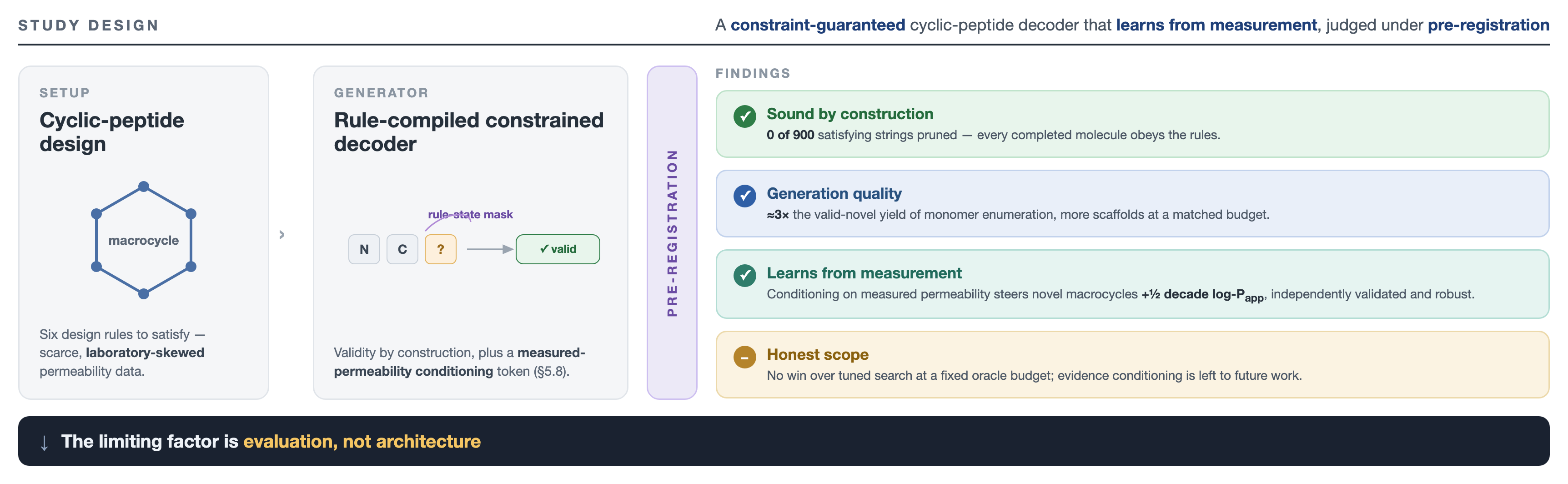
Results in brief
The problem with generate-then-filter
Most generative models for peptides produce candidates and then discard the ones that break the rules — macrocycle closure, ring size, N-methyl count, molecular-weight bounds, structural alerts. That wastes most of the output and leaves the validity of any given molecule to chance.
Rules compiled into the decoder
BioMate's generator compiles those design rules into the decoding step itself, as a token-level constraint with look-ahead and an exact end-of-sequence check. Every molecule it completes satisfies the specification by construction; across a 900-molecule test set it discarded no valid string. Validity stops being something you score and becomes something you can rely on.
Measured, not just claimed
Benchmarked against tuned baselines at a matched sampling budget, the approach delivers about three times as many valid, novel molecules as enumerating a monomer library, and spans about three times as many distinct scaffolds for the same effort — evaluated under a pre-registration that fixes the metrics and controls in advance, so the result reflects capability rather than a favorable test.
Why it matters
When validity is guaranteed, the full strength of evaluation can be spent on the properties that actually decide a candidate — chemical diversity, permeability, and ultimately target activity. That is where real progress in cyclic-peptide design is won, and it is the problem BioMate is built to put front and center.
The complete study — methods, controls and every result — is archived open-access under CC-BY at Zenodo (doi:10.5281/zenodo.24112462).
Read the full paper on Zenodo →