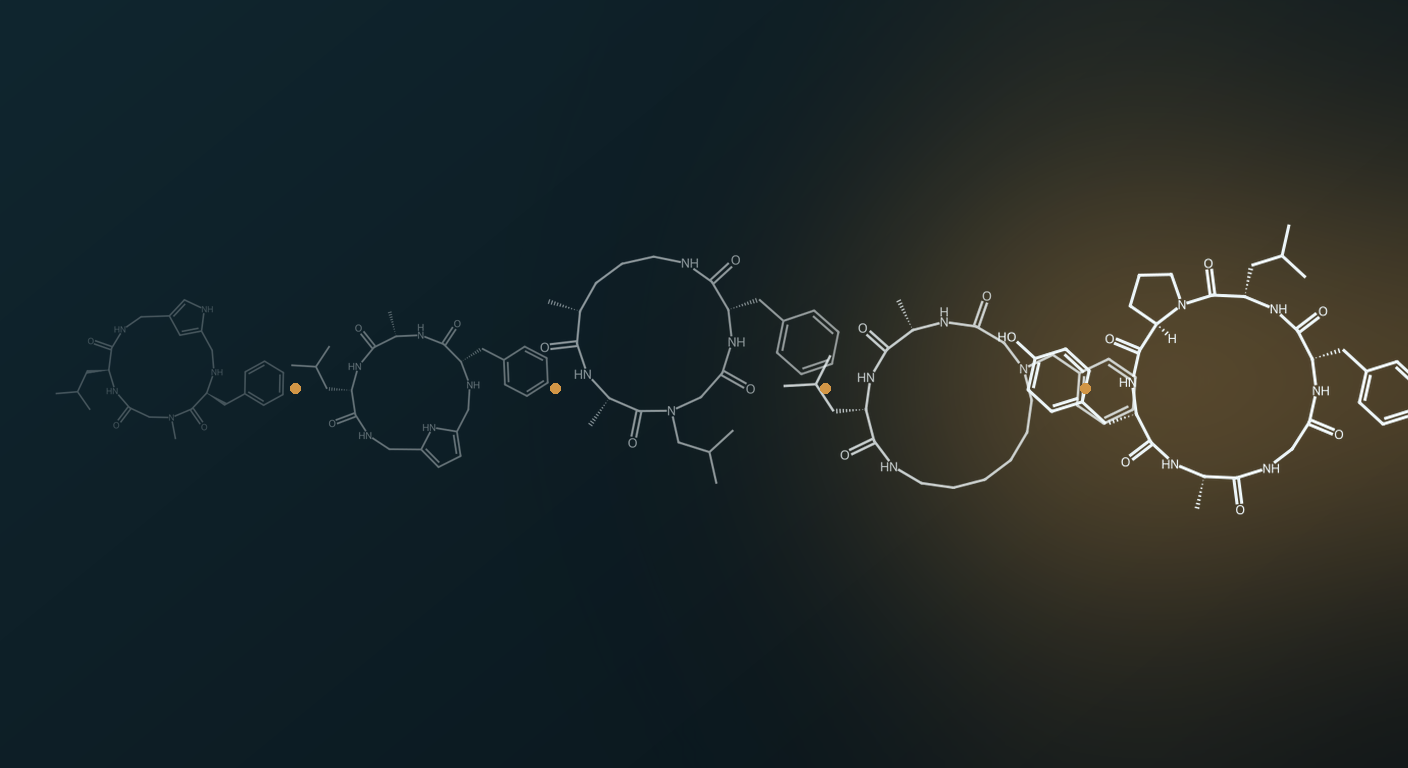
A discovery program screens candidates through a cascade of assays whose costs differ by orders of magnitude — from cheap predictors to synthesis and a wet-lab measurement. BioMate decides not only which candidate to test next, but which assay to spend the next unit of budget on.
Results in brief
The question most pipelines skip
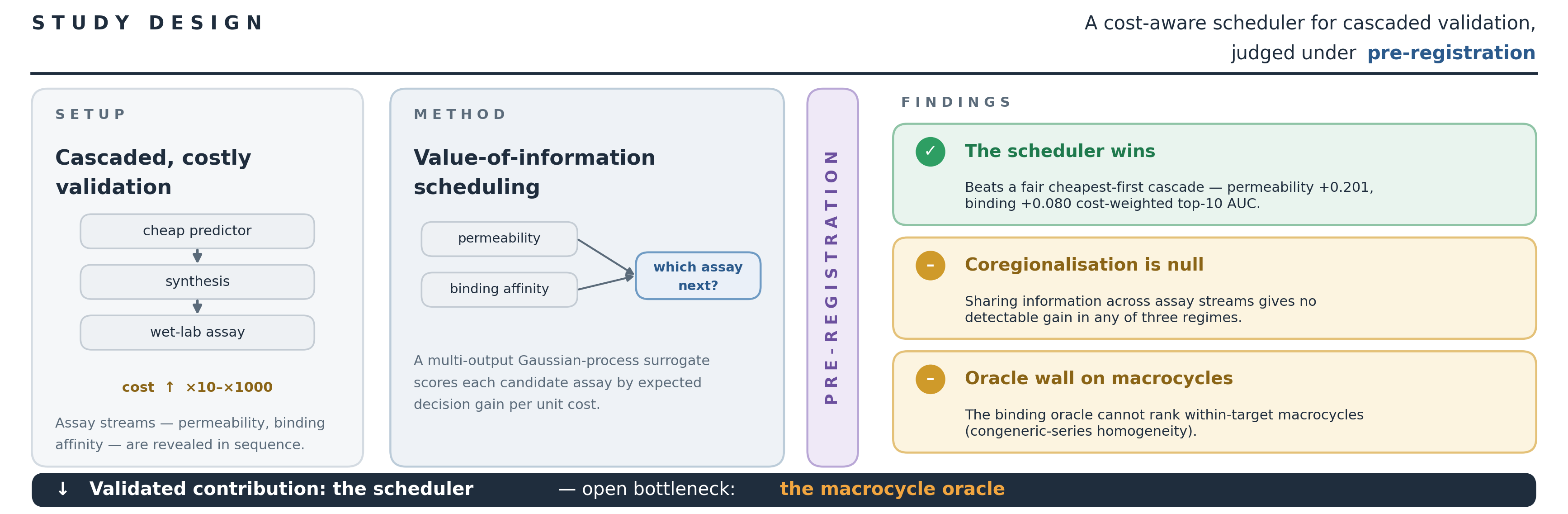
As discovery becomes automated, the expensive decision is not only what to make but what to measure. Running every candidate through the full cascade is wasteful; running the cheapest assay first is blind to where information actually resolves a go/no-go decision. That scheduling question is usually ignored.
Value-of-information scheduling
BioMate uses a cost-aware value-of-information policy: at each step it chooses the candidate-and-assay pair whose measurement most reduces advance-or-kill uncertainty per unit of cost. A cheap assay that resolves a borderline candidate can outrank an expensive assay on an already-confident one, and a resolved candidate can be dropped.
Validated under pre-registration
On real cyclic-peptide assay cascades — permeability across dozens of laboratories and binding affinity across dozens of targets — the scheduler beats a fair cheapest-first cascade, judged by a cluster bootstrap over whole laboratories and targets rather than individual molecules, so the gain reflects transfer, not overfitting to one series.
Turning a fixed cascade into an adaptive one
Choosing what to measure next, not only what to make, turns a fixed validation cascade into an adaptive loop. As discovery moves toward self-driving laboratories, deciding where to spend each experiment may come to matter as much as the molecules proposed — and BioMate schedules that spend deliberately.
The complete study — methods, controls and every result — is archived open-access under CC-BY at Zenodo (doi:10.5281/zenodo.24114055).
Read the full paper on Zenodo →