
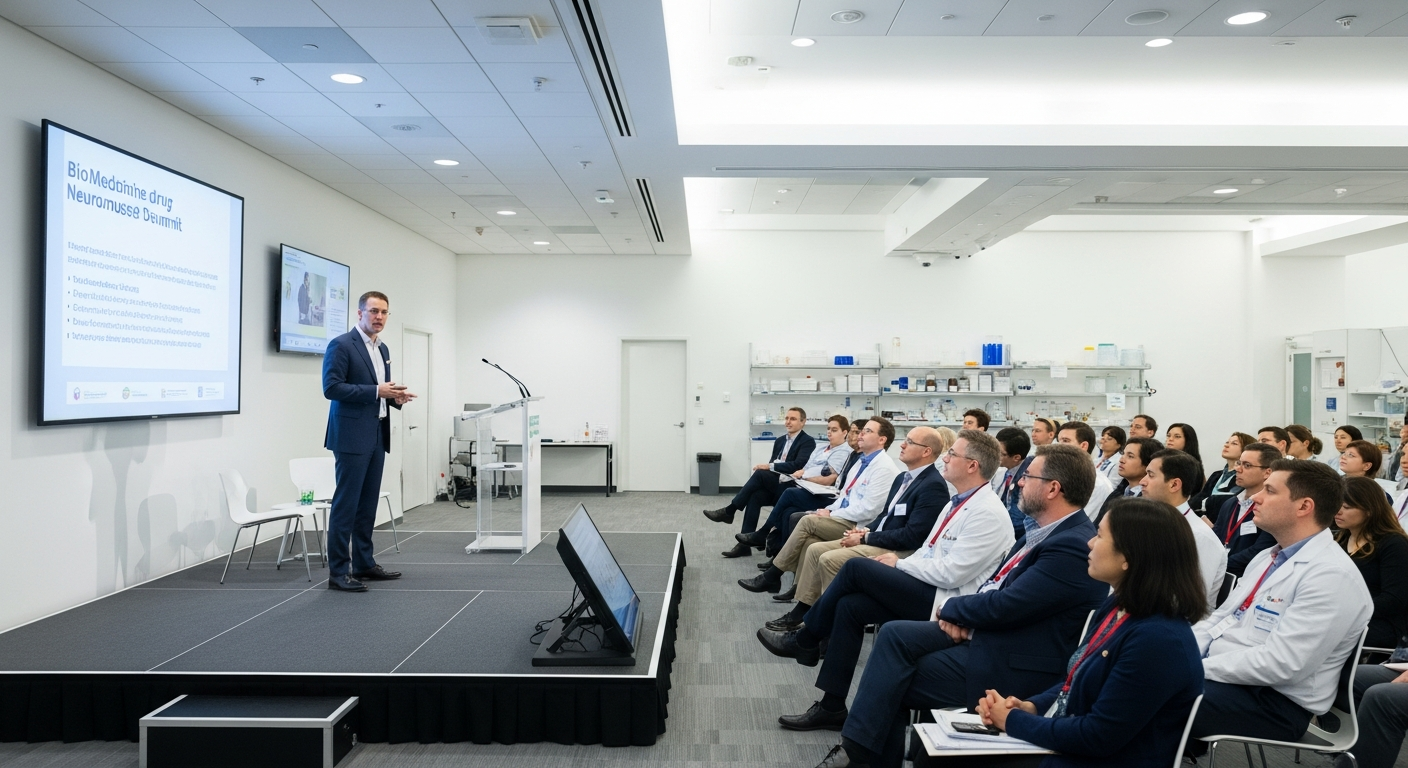
BioMate is the Innovation Partner of the Autoimmune Neuromuscular & Nerve Disorders Drug Development Summit (July 21–23, 2026 · Boston, MA). On Day 1, July 22 at 9:45 AM EST, BioMate’s Chief Strategy Officer Andrew Dike takes the stage for a talk and live demonstration — walking a real myasthenia gravis case from a public dataset to a developable drug candidate in three plain-English turns.
Four Bottlenecks That Cost Every Translational Program Months
Drug development in autoimmune neuromuscular diseases — myasthenia gravis, CIDP, GBS, MMN — moves fast scientifically but slowly operationally. The same four bottlenecks appear in every program:
- Data silos. Patient cohorts, transcriptomic datasets, and published literature live in separate systems. Pulling them together for a single analysis can take days.
- The bioinformatics queue. Every computational task waits on a small number of specialists. Questions that should take hours can take weeks.
- The bench-to-patient gap. Molecular signals identified in bulk sequencing rarely get connected to patient stratification or clinical hypotheses without a dedicated translation step.
- The audit burden. Regulatory and internal review demand a defensible, fully cited, reproducible trail for every result — and assembling that trail manually is slow and error-prone.
From Question to Cited Drug Candidate in Three Turns
Our live demo shows exactly how BioMate collapses these bottlenecks — starting not from a tidy, pre-processed matrix, but from a raw public dataset in whatever shape the depositor left it in. The case: GSE227835, a single-cell RNA-seq study of AChR+ myasthenia gravis versus healthy controls.
One plain-English question ingests the GEO series, auto-detects the deposit format (here, dense per-sample expression tables — not the 10x matrix files most tools assume), pseudobulk-aggregates 20 samples across 36,601 genes, and runs DESeq2. The real differentially expressed genes surface — every step logged, QC-checked, and reproducible.
BioMate runs gene-set enrichment on the DE genes and cross-checks the indexed literature. On this cohort the real signal is an inflammatory, TNF-response signature (e.g. GO:0071356, cellular response to tumor necrosis factor) — the actual output of the data, with citations attached, not a scripted result.
BioMate screens iptacopan — a clinically established complement-directed MG therapeutic — through a full ADMET safety panel: clearance, hERG, CNS permeability, hepatotoxicity, with QC gates enforced at every threshold. Molecule to developability verdict, in one turn.
Every dataset arrives differently: bulk matrices, 10x MEX bundles, per-sample tarballs, dense expression tables. BioMate normalizes whatever the depositor deposited, then runs genomics, pathway biology, and drug screening in one session — every finding cited, every computation reproducible, every safety gate documented. The biology you see is the data’s, not the slide’s.
Those three plain-English turns run ~30 discrete phases under the hood — format detection, pseudobulk aggregation, robust dispersion estimation, output inference, and more. Read the deep dive: Inside the Three Turns — The 30-Phase Pipeline From a Raw GEO Deposit to Drug Developability.
Where to Find BioMate at the Summit
Come meet Andrew and the BioMate team. Find us at the stand, at the networking sessions, or reach out in advance at www.biomate.ai. Full summit details at autoimmune-neuromuscular-drugdevelopment.com.